Please find our latest posts, news releases, responses to Government papers, general energy issues and further information on Joan Pye, founder of the JPP.
2019 was sadly the last year for the Joan Pye Project committee, however the admin to this site hopes to continue to work on Joan’s legacy.
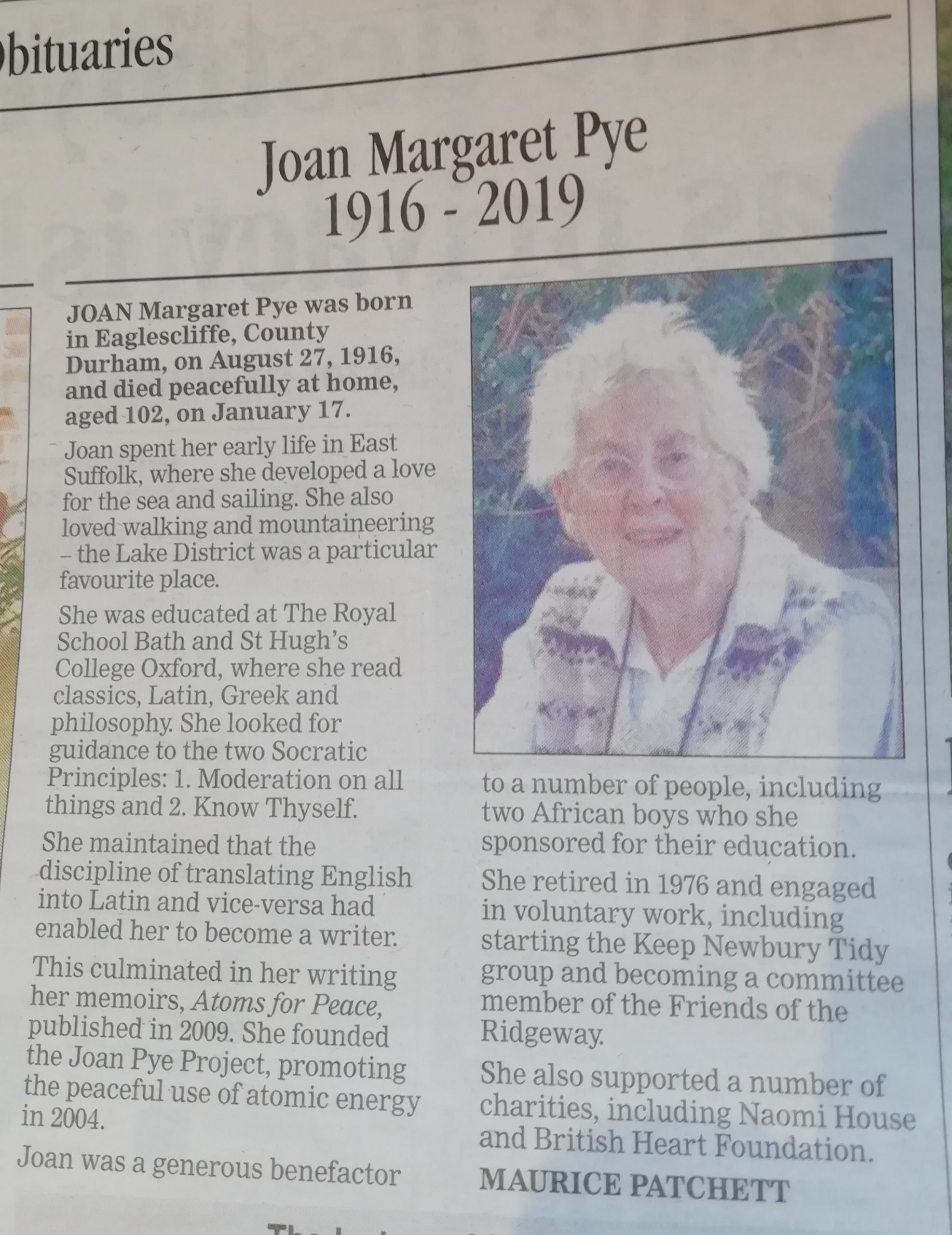
January 2019: Joan Pye Obituary:
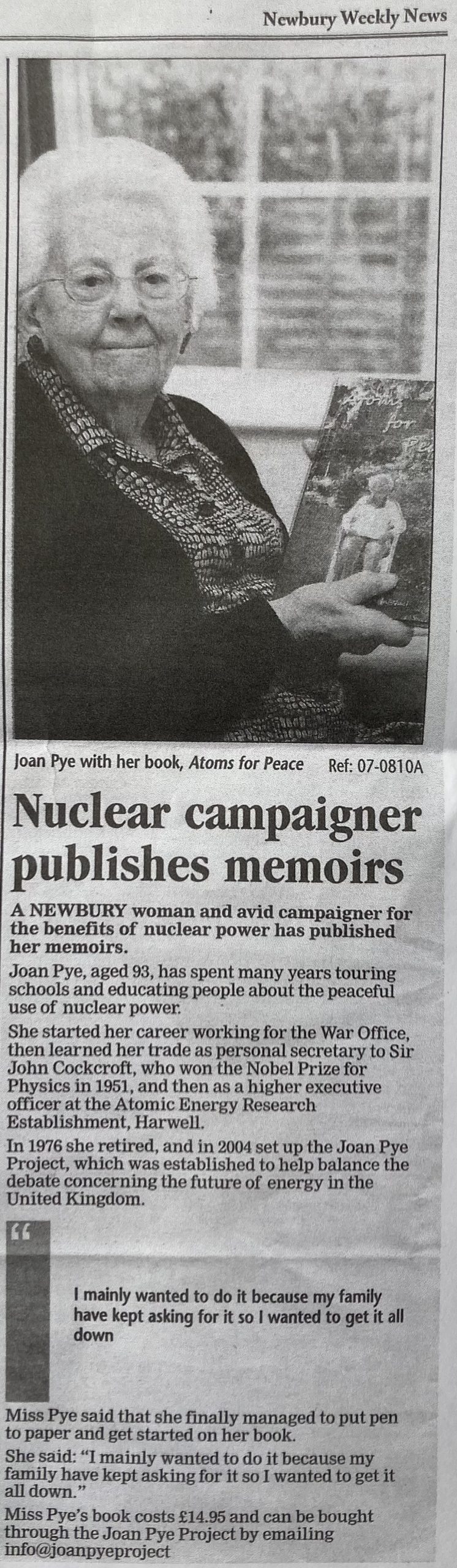
2009: Joan Pye publishes her personal memoirs
2025 (Sept): Response to Nuclear Regulatory Taskforce Consultation:
2023: Renamed Twitter handle @mums4nuclearUK, created in 2020, to @JoanPyeProject
June 2022: with SONE: Supporters of Nuclear Energy, we hosted a stall to demonstrate to members of the public how sustainable nuclear energy is.
2020: M, C & T created a Youtube video to discuss one reason why the dangers of low level radiation are overestimated. November 2020: Creation of educational illustrations: “A Bird’s Eye View“ Dec 2020: The UK publishes it’s Energy White Paper
April 2016: Professor Sir David MacKay Obituary, author of the book Sustainable Energy Without the Hot Air worked tirelessly to compute the feasibility of renewable energy for the UK and we had the pleasure of meeting David at the Cockcroft seminar in 2014. Significantly he states “I am not anti-renewables, just pro-mathematics”
In his final interview with Mark Lynas, he urged the UK to please not be afraid of pushing forward with technologies such as nuclear and even carbon capture & storage.

September 2014: A Seminar was held on The Life and Legacy of Sir John Douglas Cockcroft, OM, KCB, FRS at St. John’s College, Cambridge.
A short video message was presented from Joan to the audience, being so greatly influenced by time spent as Personal Assistant to Sir John Cockcroft in the 1950s while he was Director of the Harwell Establishment.
Please watch here; password is ‘Cockcroft’.
June 2013: A Severn Barrage? Richard Phillips submitted written evidence to the House of Commons Energy and Climate Change Committee Report:
“The concept of a tidal barrage running across the Severn Estuary from Cardiff-to Weston has a long history. The last proposition was put forward in the first decade of the 21st century, but was put to one side. At that time a 70 page document was produced, purporting to examine all aspects of the project. I searched the whole of this work, seeking the results of any technical assessment of the impact of sedimentation, induced by flow restrictions, inevitable in such an undertaking. I found none. As a scientist, this aspect of the physics of the undertaking was of primary importance, since silting, on the scale which I would consider inevitable would rapidly take place. A reference on the Web states that “However, the barrage has caused progressive silting of the Rance ecosystem”. Though operating under a different regime, the Aswan Dam suffers immense silting problems, both in loading the dam itself to the point where flow into the turbines is in danger of being affected, and of denying the rich silt to Egyptian agriculture. The physics of sedimentation is well known. Whenever a solids laden fluid stream with a stable suspended burden of solids suffers a reduction in its velocity, the solid particles fall under gravity. This is absolutely inevitable. Inhibition of the flow of the Severn Estuary will inevitably take place, in total disregard of the manner in which the generation pattern is operated. The experience of the construction of a “causeway”, essentially a dam-like structure, on the Petitcodiac River in Canada, illustrates the havoc that the impedance of a muddy river create. Another matter to be addressed is the pattern of generation. Tidal cycles are completed in approximately one terrestrial day; but not quite. The cycle is in time with the lunar day, and thus tidal movements occur at different times every day, at precisely known times. Generation is in time with this shifting pattern. The average output from the turbine installation is not the headline turbine output, but approximately 50% of this value. This is due to the ever-changing driving force on the turbine, a reflection of ever-changing water level differences. I am a retired research scientist, having spent the last 35 years of my professional career at the Atomic Energy Research Establishment at Harwell in Oxfordshire. Since retirement I have continued to take a keen interest in all energy matters, and have a wide circle of very experienced contacts in all aspects of the industry. I have thus acquired a wide knowledge of the spectrum of energy matters from nuclear generation to renewables. I became, by examination, an Associate of the Royal Institute of Chemistry in 1954, and was elected a Fellow in 1971.”
March 2013: Visit from Professor Emeritus Wade Allison
Possibly the top issue the public have about nuclear power is fear of radiation. Professor Wade Allison understands the numbers concerning radiation and is of the opinion that the public are unnecessarily fearful and grossly misguided by the media concerning radiation risks of nuclear power.
Wade Allison is a Fellow of Keble College and Emeritus Professor of Physics at the University of Oxford where he has studied and taught for over 40 years. An interview with Wade Allison, by RTE News can be found here: ‘Irrational fears’ holding back nuclear power solutions. He cannot understand why there are such irrational fears regarding radiation, whilst respectful that a ‘safe’ dose needs to be identified to avoid biological damage. He has also written a book called Radiation and Reason translated into several different languages, which can be downloaded via the link.
He came to present to Joan Pye his observations on the public reaction to radiation, as a particle physicist has spent his professional life studying the behaviour of atoms. His aim is to encourage a generic understanding of radiation, so to rationalise public fears about radiation and so ensure precautionary principles made are appropriate to the level of exposure. View here the Radiation and Reason Powerpoint slides with notes.
26th February 2013 Dr Sue Ion (OBE)
The former technical director of British Nuclear Fuels, Dame Sue Ion, discusses a lifetime of working in the nuclear industry. When Sue got her first job at a nuclear fuel fabrication plant in Preston, nuclear power was generally seen as force for good but, during the dark decades post Chernobyl, it was a hard sell. Still, Sue continued to push for investment and innovation in the industry and in 2006 persuaded Tony Blair to change his mind about nuclear power, insisting that if Britain is to have any chance at all of keeping the lights on and cutting its carbon emissions, we will need to invest heavily not only in renewables like offshore wind but also in a new generation of nuclear power stations.
The interview on BBC Radio 4’s show ‘Life Scientific’ between Jim Al-Khalili and Dame Sue can be found here.
February 2013
Obituary Terry Price (1920-2013)
It is with much sadness that we receive the news of Terry Price’s recent death.
Terry was an eminent research physicist who arrived to work at Harwell at a similar time to Joan in the early 1950s. They remained close friends ever since.
During their time at Harwell, he founded a singing group called ‘the Fish Pyes’, to which Joan was pianist. On leaving Harwell, he became scientific adviser to the MOD. In 2007, Terry was interviewed on a BBC documentary about the Windscale accident where he worked as a plant operator at the time. His air fiters helped to avert disaster when the nuclear reactor caught fire in 1957.
We at the Joan Pye Project are much in debt to Terry for all his help and support both at the foundation and the running of the Project. He will be sorely missed.
There is a full page obituary in the Times, published 5th February. Please find here http://www.thetimes.co.uk/tto/opinion/obituaries/article3677776.ece
Obituary Dr Alan Linsley Shaw MIET(1917- 2011).
Sincere Condolences to the family of Dr. Alan Shaw, who died recently. Alan was a valuable contact of the Joan Pye Project, and had great wealth of knowledge concerning electricity distribution in the UK.
The Role of Nuclear in meeting the 2050 Climate Target
On the 24th June 2010, Duncan Rimmer of the National Grid gave a lecture at the Nuclear Institute’s Central England Branch’s AGM. His slides are recommended reading to be viewed here:
2050 Gone Green Nuclear Group June 2010
POLITICIANS NEED INDEPENDENT SCIENTIFIC COUNSEL TO AVOID WASTING MONEY ON GREEN ENERGY SCHEMES
23 March 2009: The Joan Pye project calls on the UK Government to get immediate, independent scientific counsel, as Barack Obama has done, to obtain realistic appraisals of low carbon energies and costs to avoid wasting of tax payers’ money.
The Government’s Low Carbon Industrial Strategy and the Conservative’s latest green paper both call for investment in untested, expensive technologies and costly changes to the National Grid. If these politicians had a scientific or technical background, they would see these as unviable and prohibitively expensive.
In their rush to trial carbon capture and storage why have Lord Mandelson and Ed Milliband not noticed that if CCS is such a great white hope, why has industry been so slow to invest?
Probably because just one day’s production of CO2 would need a tank one thousand metres long, twenty four metres wide (almost the whole of a three lane motor way), and ten metres high (a three storey house) for storage, so imagine decades of production. Also, as CO2 must be stored as liquid, it would have a high 800psi pressure (25 times as much as car tyres) so its release would be inevitable. And this would lead to an increase of about 3 times current electricity prices.
As for renewables, while wind, wave, tide and sun may be abundant, their chaotic and dilute nature means they would need huge installations, covering potentially whole counties, to harvest the same amount of energy a conventional power station.
Commented Joan Pye, founder of the Joan Pye Project (www.joanpyeproject.org) said: While tax revenues are so low, this is not the time to have knee-jerk reactions and make foolish, costly decisions. Investing in untested, unproven, expensive technologies, which produce more carbon than nuclear is crazy. Joan added: Most of our lighting, machinery, trains and cars can be run by low carbon electricity, as nuclear produces the lowest carbon footprint of electrical generation. The French do it now with over 80% nuclear power and cheaply too, why shouldn’t we? ENDS
NEWS RELEASE
Why Nuclear Energy can enable us to meet 2050 targets
Newbury 22 October 2008: With tough EU emissions targets announced on Friday, attention has been focused on alternative energies to minimise reliance on carbon-based fossil fuels. Yet the lowest carbon emitting fuel is nuclear – so why isn’t it included on the low carbon/renewable energy agenda and why has all the emphasis has been on “renewables”? Could it be because the mandarins in Europe did not understand its low carbon properties? Or are suffering from mis-conceptions?
While the French who have over 80% of their electricity provided by nuclear energy may make the scientific arguments, isn’t this discussion a perfect start for the new Climate Change minister Ed Milliband to get his teeth into?
Joan Pye, founder of the Joan Pye Project, www.joanpyeproject.org, a group of scientists independent of Government and other political and commercial organizations, said: “If the UK Government goes ahead to produce over 40% of its energy using clean nuclear technology, we could then have all the power we needed for industry and use our emissions quota to cover road transport.”
40% of nuclear power would be needed to cover the base load required by the national grid to be ‘always available’, while renewable or more nuclear energy could contribute to peak load to meet higher demand.
Joan Pye added: “If we also electrified our trains (again like the French) to reduce our carbon footprint and incentivized home owners to move over to storage heaters, we could easily meet the 2050 target of reducing our carbon emissions by 80 per cent.”
ENDS
Please find below and attached a diagram to show that Nuclear emits lowest carbon dioxide.
NOTES TO EDITORS
EU BACKGROUND
The origin of the problem lies with those drafting the European-wide Renewables Obligation who appear to have lacked a scientific or technical background and understanding when studying minimal carbon technologies. At an early stage in their deliberations, the EU Committee made a clear distinction between nuclear energy and “renewables”, instead of regarding both as low carbon means of electrical generation. This meant that only “renewables” were accepted as the official name, so stopping the lowest of the carbon technologies, namely nuclear power, to be included in the low carbon technologies acceptable to the EC.
WHY RENEWABLES NEED FOSSIL FUEL BACK UP
Wind or solar power require an equivalent and instant back up capacity from other forms of energy generation, for every 1,200 – 1,500 wind turbines built to generate 1000Mw of electrical output (a typical power plant) you also need to build another coal/gas/nuclear plant to generate a further 800 MW of electrical output to make up the deficiencies in times of low winds and high demand.
DIAGRAM TO SHOW NUCLEAR EMITS MINIMUM CARBON DIOXIDE
If you examine the “green” qualities of each fuel by measuring the amount of carbon generated for each kilowatt hour (KW/Hr) of energy produced, taking into account the complete lifecycle of each technology, it is the nuclear option that produces least carbon, just 4g of carbon dioxide per KW/hr of electricity generated, which is half the carbon produced by wind.
Information courtesy of the British Nuclear Energy Society using data from the Government’s Energy Technology Support Unit, and confirmed by the OECD. The figures are taken over a complete life cycle of the relevant technology.
IGNORANCE AND FEAR SHOULD NOT DICTATE BRITISH ENERGY POLICY
– the truth about “low carbon energy” – a new campaign to balance nuclear debate
Fear, ignorance and misconceptions should not dictate the debate over Britain’s future energy choices argues the Joan Pye Project. Until now “green” campaigners have dominated the arguments for clean and green energy and clouded the discussion with semi-scientific opinion. So 91 year old Joan Pye, a veteran campaigner, today launches a new campaign www.joanpyeproject.org to fill the information gap and give the British public a more balanced view of the energy options available.
Joan is still the driving force behind an independent network of many physicists, chemists, and chartered engineers who have spent the major part of their careers in the nuclear industry. They believe that despite all the hype, the technology behind renewable wind energy cannot be developed in time to fill the projected energy gap. Also that the issues and flaws in the renewable argument, such as the enormous scale of wind farms, cost of subsidies, huge back up capacity required to stop the grid crashing when the wind stops blowing, have been glossed over.
The Joan Pye Project’s core team argue that nuclear offers the most affordable (no subsidies), safe, clean energy available which will help combat global warming through its sustainable and efficient “carbon free” energy production.
Passionate about the contribution nuclear generated electricity can make, Joan Pye commented at the launch: “A proper balanced scientific debate is needed to show how nuclear can be a long term solution to spiralling energy costs and solve the looming the energy gap.”
The Joan Pye Project, with its direct connections to the new Nuclear Institute, aims to educate, inform and allay genuinely held fears, while demonstrating that nuclear power is the best way forwards.
ENDS
NOTES TO EDITORS
Joan Pye’s working experience at the Atomic Energy Research Establishment, Harwell, convinced her that nuclear power is indeed the “Energy for the Next Generation”.
The Project (JPP), which she established in 2004, generated its own funding and is totally independent of Government departments or other political organizations.
More Information
Articles and Papers: renewables-misnomer
Technical report: nuclear-waste-report