Renewable energy, many think, is the answer to all our energy issues. Serendipitous images sold to us by those wanting to cash in on Government incentives, main stream misinformation and lack of true clarity, have resulted in a kind of public duping.
There is no fault in wanting to minimise our reliance on carbon based fuels, from green house gases to asthma-inducing particulate pollutants.
But are wind, solar and tidal power really the answer to affordable, plentiful and low carbon electricity? Why are these technologies not successful, when, despite many years of Government initiatives, energy prices and greenhouse gas emissions continue to rise?
* Of the energy generated from renewable sources, in 2017, two thirds of this renewable energy was attributed to bioenergy. I.e. Drax, and Energy-from-Waste schemes etc
* Renewable power generation is not as green as you might think when you take into account materials such as concrete, glass and steel needed for a lifetime’s supply. Nuclear has a high energy density which is is 10 billion times bigger than for renewable energy sources considered below (due to the tiny Planck length of the atomic nucleus).
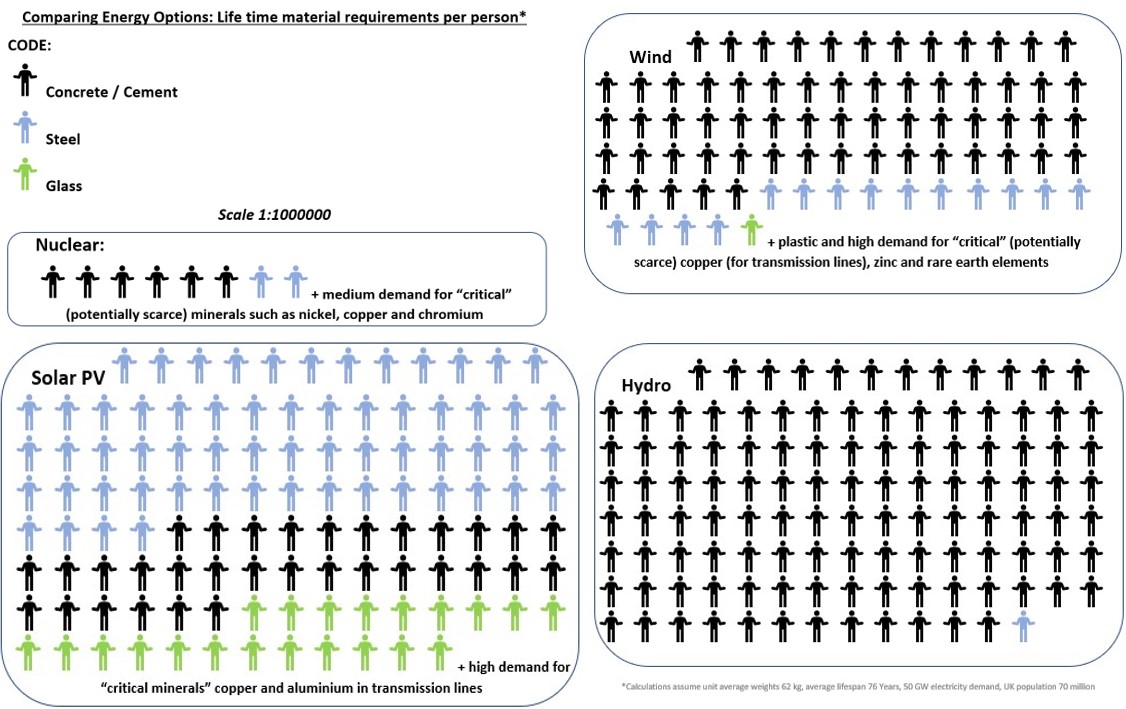
* If the UK covered every roof with solar panels, and all accessible coastline with wind turbines, we’d still only have a fraction of the electricity supply necessary to meet demand.
* Variable weather-dependent power is intermittent so that when the wind drops (or the sun goes down), the power stops and this is backed by a significant amount of gas.
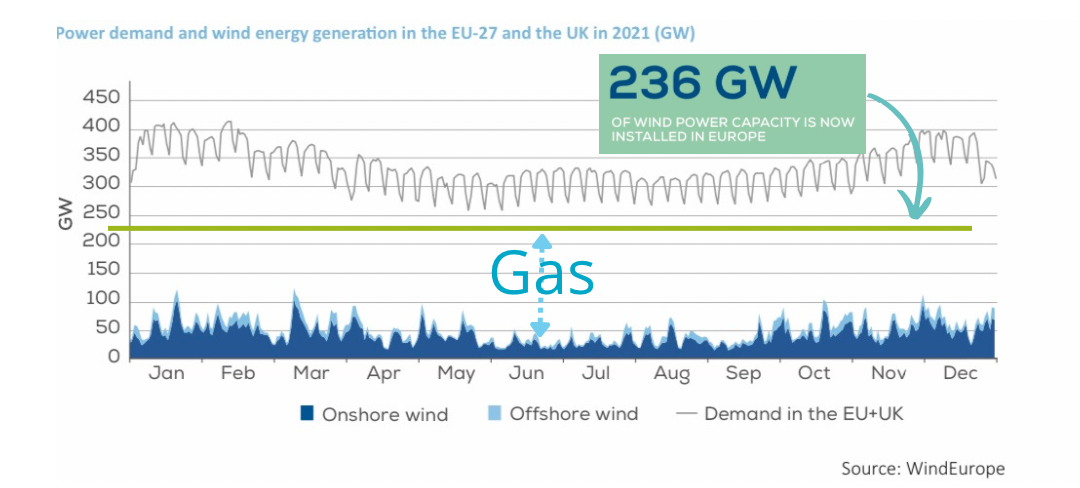
* We need 50GW carbon free electricity. At present we cannot even use the renewable capacity to offset retiring coal-fired and nuclear power stations.

* Renewable installations require significantly larger land footprints to deliver equivalent volumes of power. The new solar farm proposed by EDF in Cambridgeshire will deliver only 0.01% of the UK’s electricity needs, despite being nearly the same size as Cambridge itself.
* As renewable energy cannot be stored and is difficult to manage, despite heavy investment in battery power and smart grids.
* There are now over 1600 wind farms in the UK, which can produce large quantities of energy, which can be wasteful when it is deemed superfluous to requirement.
* The “quality” of our electricity is very important, since microprocessors and electric motors rely on the stable voltage and frequency of the supply to work properly. It was an important achievement of the 1926 Electricity Act to unify the voltage and frequency throughout the UK by joining up selected large power stations, working in unison through the “Grid”, to give us our present reliable high quality electricity. A multitude of turbines is reversing this process, and if continued to any great extent, would endanger the quality of our electricity and possibly cause power cuts.
* Until recently, heavy subsidies were available in the way of Renewable Obligations Certificates (ROCs).
Biomass – burning wood for energy
Burning wood instead of fossil fuels has its own problems. To plant enough willow to keep a single 1,000 MW (e) power station operating would cover an area bigger than Kent. As wood is cellulose, a carbohydrate, less than half of its weight (the carbon part) burns to produce heat, the rest evaporates as water; it is thus half as productive per tonne as coal and is actually very poor in energy content. To keep up with our renewables obligations, the UK burn wood chip in combination with coal in conventional power stations at Drax and Ironbridge.
Wind
Wind power is the largest renewable energy provision in the UK according to figures presented by the suppliers in 2019. If the wind farm supplies more than the grid requires, the windfarm suppliers are asked to switch off and then require compensation. This payment makes up a large percentage of the Balancing Use of System (BSoUS) section you can find on your electricity bill [Ref].
Back Up Power
In general, the national grid relies on a steady controlled generation of power from generators and turbines. This can be supplemented by occasional “chaotic” power generation such as that provided by wind and solar, but cannot depend upon it. To avoid black out and “crashing” the grid, wind power and other renewables must be supplemented at all times by a back up generation capability equal to 80-90% of the installed renewable energy capacity, so that when the wind drops, the tide turns or day turns to night there is reserve to avoid failure.
Land requirements
In addition to the back-up demands, the dilute spread of technology such as wind turbines require vast areas of land or sea to generate the same output as a single conventional power station. To produce 1,000MW of electrical energy – the size of an average power station – nuclear requires the equivalent of 10 soccer pitches. Wind (when it is blowing) requires an area the size of Dartmoor, and solar would need half as much again; biomass (wood) needs a forest the size of Wales. Britain currently needs at least 55 of these 1,000MW(e) power stations to meet peak demand and renewables come nowhere near to meeting the requirement.
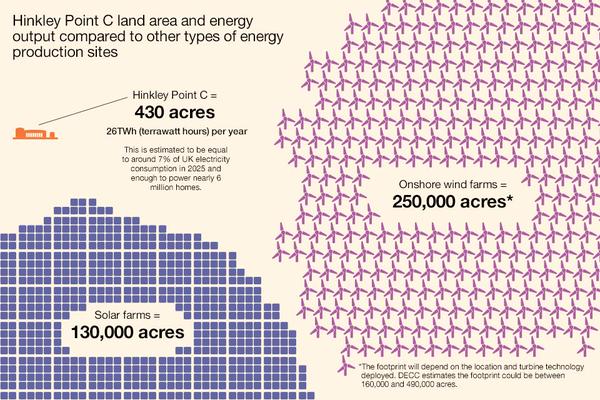
An equivalent wind farm is estimated to require in the region of 400-1000 times more land than a nuclear powered facility.
Without government subsidies, many of the existing and proposed wind farms we currently see would be uneconomic. Some have estimated that wind power is roughly twice as expensive as that of conventional fossil fuel based power, [see ‘cost’], as defined by the ‘strike price’ – i.e. that which is agreed by the electricity seller, based on predicted market demand.
On the one hand, it is thought that the potential for wind and other renewable power could be improved by the use of batteries to viably store energy, but others believe such technologies blight the landscape and or cause noise pollution, have a relatively short lifespan, and damage eco-systems due to such as bird strike.
Solar
The issues with Solar energy are much the same as wind. It can only be collected 50% of the time ie during daylight, and only then when there is no heavy cloud cover. The fixed solar panels vary in output throughout the day, as sun rises to a maximum and then declines. Therefore efficiency is low until improved photo voltaic technology is developed. Heat collectors on the roof to warm up water for domestic or industrial use are useful, however they aren’t a recipe for self sufficiency. Even in perfect conditions, the amount of energy available has a modest upper limit.
Wave power – tidal streams
For tidal streams to generate a reasonable amount of energy ie 1000 MW, 1000 turbines are needed. The capital cost is quite high, the carbon emissions are low, but as the generation of tidal power is not constant and electricity can only be generated when the tide is running, it too has to be supported by 80% of the installed renewable energy capacity, to avoid black outs.
Anti-Nuclear Bias
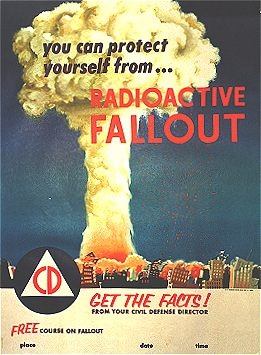
Nuclear has, until recently been excluded from the energy debate because of radiation fears. Misinformation on radiation stems from the linear no threshold model imposed during the Cold War era. Understanding the differences between a nuclear reactor and a bomb can help to reduce fear: we see how effective images of cold-war propaganda can be at inducing damage when the resultant mass hysteria from accidents such as those at Chernobyl & Fukushima meant more people died from evacuations and nocebo effect than would have otherwise done had they stayed home exposed to low levels of radiation.
In France, 75% of their electricity is produced by nuclear power which took 15 years to build out. This is an achievable goal, but Government need to commit the funding to cover the high upfront costs.
Conclusion
So what to do? We shouldn’t completely discount renewable energies. Solar panels can make sense on traffic road signs and calculators for example. But to deal with the energy crisis facing us in terms of the growing gap between capacity and demand we have to refocus the debate and look at a balanced power generation solution for the UK, embracing a mixture of technologies which above all includes Nuclear.
Download our White Paper: renewables-misnomer