Frequently Asked Questions
Why can’t we continue to produce power from fossil fuels?
Three reasons:
1. As a net importer of fossil fuels here in the UK, we no longer have security of supply which means we can’t be sure we’ll always have the fuel we need.
2. Fuel is bought at world prices, and those prices are increasing, so is the cost of the electricity we consume.
3. Burning fossil fuels such as coal and gas produces chemicals which are hazardous to health, and large quantities of carbon dioxide – CO2 – the primary contributor to the phenomenon of climate change.
What about free energy from renewable sources?
While the idea of free renewable energy sounds great as a concept, it is either chaotic in its availability or available only at regular but fixed times. All renewables are very dilute, and thus require huge installations to harvest them. Renewables have to be complemented by conventional fossil fuel derived power generation to ensure we always have a supply. Renewables are also very resource intensive to implement for the amount of energy they produce, so the environmental credentials are very poor when you take into account the impact of mining and end of life disposal.
Isn’t Nuclear power dangerous?
No. Nuclear power has had a very safe history under close supervision by official inspectors. The amount of radiation to which the population has been exposed from nuclear power is comparable with the natural radiation received when flying for only a few hours at normal altitudes. It is, in fact, far less than 1% of that received in the course of a normal lifespan.
Our fear of radiation stems from politics, propaganda and Hollywood sc-fi, and has also been blown out of proportion by uninformed activists who confuse nuclear energy with nuclear weapons.
What is more, there is strong evidence to dispute the model upon which the industry-standard ‘safe’ dose limits are based. Sources: SARI, Nature, Energy and Society
Does that just leave nuclear power stations?
For the production of large, reliable quantities of electricity, yes.
Renewables, such as wind and tidal power, even where growing fuel to burn, cannot provide the “base load” needed to be on tap, all the time, and in sufficient quantity.
Over one thousand turbines would replace just one nuclear reactor. In terms of biomass, to replace just one reactor at the Dungeness (Kent) power station, would mean growing willow over the whole of the county of Kent, i.e. one million acres.
What happens to all the radioactive waste from reactors?
Radioactive waste is generally stored on the site it arises, safely, in accordance with the relevant site license. High level waste may be left in a cooling pond (below), and once it dies down to intermediate level waste, for example, is generally sealed in drums and can be stored in a place accessiblr for reprocessing if deemed viable. More often than not it is the chemical effects of the heavy metal contaminants that people worry about which might be more concerning than their radioactive properties, but even then, the risks are not worth worrying about in the way that people tend to believe they should. The technical processes for waste storage are well understood, and storage is relatively inexpensive. 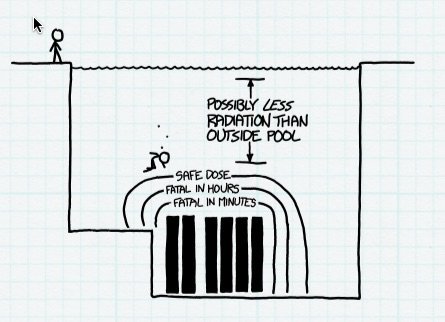
This image (credit to XKCD Comics) shows how effective water is at shielding workers from radiation emitted by spent fuel rods.
New generation reactors’ waste will be much smaller in volume as much will be “burned up” in situ and used as energy to power the reactors.
A natural fission reactor occurred underground in Oklo, Gabon about 2 billion years ago. Most of the non-volatile fission products and actinides have only moved centimeters in the veins during the last 2 billion years.
Can terrorists get into reactors and blow them up?
No. Nuclear power stations are really quite small and are made very secure against these sorts of attack. The reactors themselves are behind immensely strong reinforced concrete shields. They are constructed to be earthquake proof and resistant even to large aircraft crashing into them.