Author: benzabell

  • What about the waste?

    21/05/25 by Marie

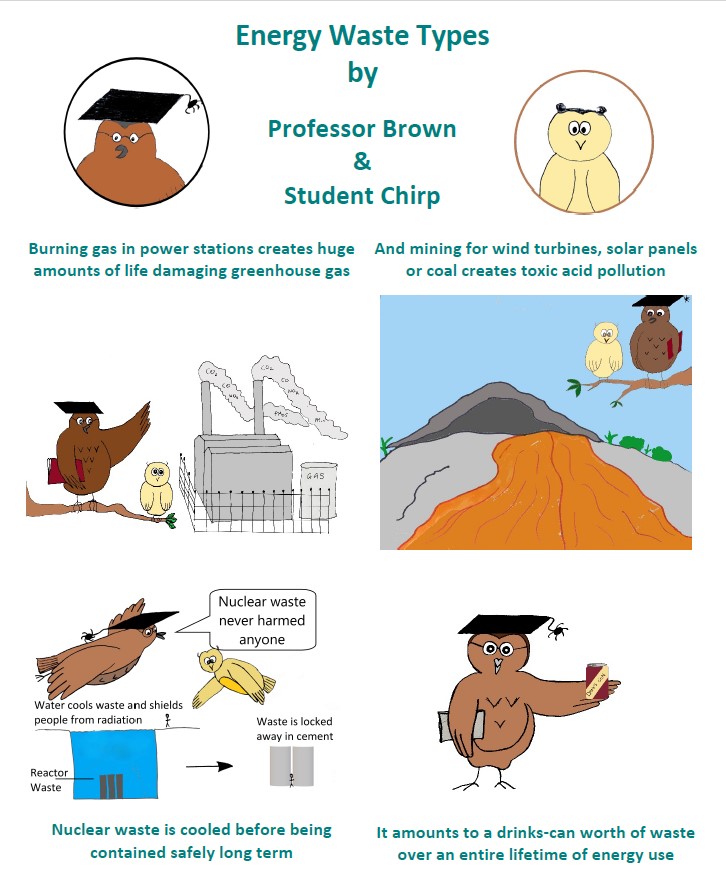
    Contrary to media reporting, radioactive waste is not a public health hazard, and it never hurt anyone. The issue of public mistrust is discussed here.

    Emissions from burning fossil fuels, on the other hand, cause devastation worldwide by contributing to more frequent and intense extreme weather events like typhoons, droughts, and famines.

    Also note significant chemical waste arises from the materials needed for intermittent energy technology around which the grid burns gas.

    The nuclear industry is held to incredibly high account for the waste produced. The radioactive content mostly consists of heavy metals, and this is published in the publicly available UK radioactive waste inventory. A natural fission reaction below Gabon, which happened 2 billion years ago, and the ‘waste’ is still there; it hasn’t harmed anyone or anything.

    Secondly, from the discussion with Dr Pete Bryant of Sizewell C, it is pointed out that although people immediately think of radioactivity from nuclear fission, the issue in practice is more about the excess heat that, for thermodynamic reasons to do with the Rankin/Carnot cycle, like with any thermal plant, poses more of a problem for those occupied with building a nuclear power station than the very small amount of contained solid waste.

    Third is the consensus around what constitutes the level of radioactivity that we should be concerned about. 

    The current regulations for ionising radiation are largely based on a dose-response relationship established over 80 years ago by Herman Mueller, using very basic technology at the time. This framework operates on the unproven assumption of a stochastic effect that only ‘no dose’ is a safe threshold.

    See our 3 minute video which explains the problems of LNT:

    However, with advancements in monitoring technology, we now know that low background radiation exists globally, and our bodies are well-adapted to it.

    Given the nuclear industry is regulated to ensure public exposure doesn’t exceed 1 mSv per year (for perspective, this is lower than the natural background radiation in Cornwall, which is 2.7 mSv), it’s little wonder why nuclear new builds have become increasingly costly and timely. In some areas of the world, background radiation levels exceed 200 mSv with no adverse health effects observed in those populations.

    It seems we have a choice: either we base our regulations for low-dose radiation on actual evidence, or we apply equivalent pollution levies to greenhouse gases.

  • Small Modular Reactors

    Small Modular Reactors (SMRs) are part of a new generation of nuclear power plant design being developed in several countries to supply small communities.

    Other than residential electricity capacity – which could theoretically support a small city in the UK residential capacity and not much else, their design is also suggested for use in high-power industrial units.

    The idea behind SMRs is that they will be pre-manufactured at a plant and brought to site fully constructed, which is optimal in remote areas. While the smaller power output of an SMR means that electricity will cost more per MW than it would from a larger reactor, the initial cost of building the plant is much less than that of constructing a more complex, large nuclear plant, making the SMR a smaller-risk venture for power companies than other nuclear power plants.

    Small Modular Reactors (SMRs) have been a catalyst for renewed interest in the possibility of using smaller, simpler units for generating electricity from nuclear power. This interest is also driven both by a desire to reduce overall cost and to provide an alternative source of power to large grid systems.

    Of the designs available to us here in the UK, the integrated pressurised water reactors are most technologically ready, such as those already used in submarines. There are estimated to be in the region of over 45 SMR designs under development in the US, Europe, China and elsewhere for various purposes [SOURCE: IAEA Advances in Small Modular Reactor Technology Developments].

    The UK’s Penultimate Power and the Japanese Atomic Energy Agency  are working on a High Temperature Gas-cooled Reactor (HTGR),a nuclear reactor that uses graphite with a once-through uranium fuel cycle.  It is a design already operating in Japan, and is to be ‘walk away safe’.  It uniquely provides carbon-free heat up to 950oC for industrial processes, including green hydrogen at point of use via the sulphur-iodine process [2].

    Moltex are an UK-Canadian venture who have developed a stable salt modular reactor ready for implementation. The liquid salt fuel mixture is contained within solid fuel assemblies. The fuel assemblies are then submerged in a pool of pure liquid salt coolant.

    Others include the simple boiling water reactor design: BWRX-300, by Hitachi, the high temperature reactor design by Cavendish Nuclear or the larger units proposed by Rolls-Royce.