21/05/25 by Marie
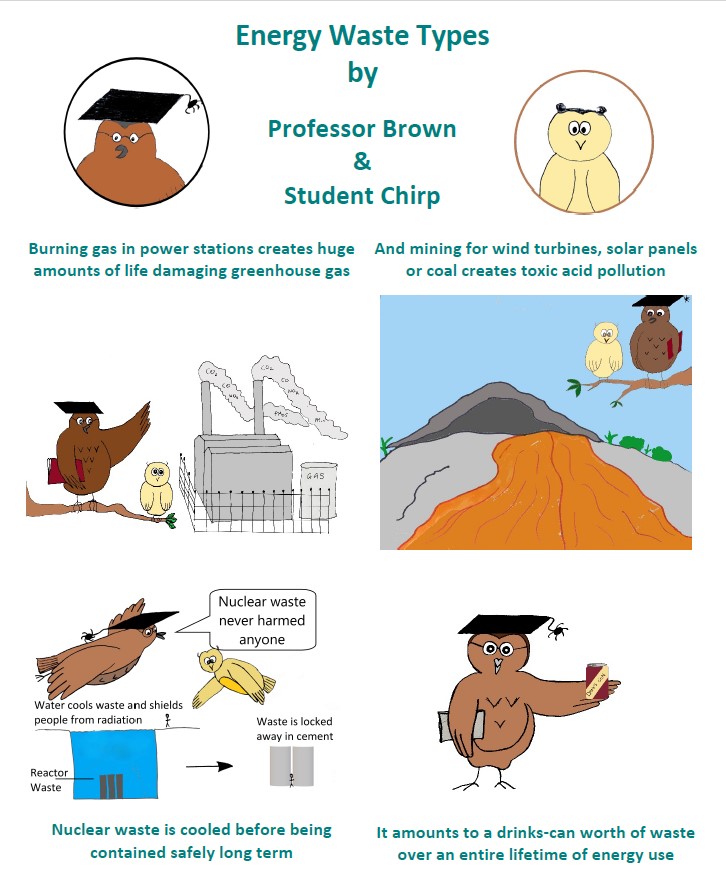
Contrary to media reporting, radioactive waste is not a public health hazard, and it never hurt anyone. The issue of public mistrust resulting from mainstream propaganda is discussed here. A natural fission reaction happened below Gabon, 2 billion years ago, and the ‘waste’ is still there; it hasn’t harmed anyone or anything.
The Simpsons’ three eyed fish is unrealistic. When Herman Muller investigated ‘mutations’ to cells from ionising radiation (X-Rays) in the 1920s, mistakes were made, creating an overcautious approach to low level radiation. So, apart from natural background anomalies, the ICRP now very much overestimate the potential for radiologically induced cancers from low level radiation (ie less than 100 mSv). In addition, the sci-fi industry exaggerated the word ‘mutation’ into macroscopic inheritable defects. The truth is that chemical poisoning, consider, e.g. tar vs polonium in cigarettes, is far more damaging.
Chemical properties of wastes ought generally to be considered in context against radiological properties for energy wastes. Consider the knock on effects of combustion of fossil fuels, a chemical reaction which produces an uncontrolled waste stream of carbon dioxide and water. For example we can see that one molecule of methane reacts in an irreversible process with oxygen and this creates one molecule of carbon dioxide and one molecule of water. CH4 + 2O2 => CO2 + 2H2O .
As carbon dioxide (CO2) from burning fossil fuels accumulates in the relatively thin atmosphere where it stays for hundreds of years, and uniquely, those electrons around the carbon dioxide molecule absorb and re-emit heat (infra-red radiation), it means there is mainly more energy of this range trapped beneath the stratosphere.
As a result of this increased trapped energy we are presently seeing more frequent and intense extreme weather events like typhoons, or droughts, resulting in excess deaths from heat stroke, famine, disease and pestilence, yet current energy policies do nothing to prevent the wastes even though the world temperature has increased by 1.5 degrees since the start of the industrial revolution and is accellerating up.
Although the nuclear industry does not create carbon dioxide, it is still held to an incredibly high account for the radiological wastes which are cooled and contained. The radioactive content mostly consists of heavy metals, and this is published in the publicly available UK radioactive waste inventory.
In fact, from the discussion with Dr Pete Bryant of Sizewell C, it is pointed out that although people immediately think of radioactivity from nuclear fission, the issue in practice is more about the excess heat that, for thermodynamic reasons related to the thermal plant, pose more of a problem for those occupied with building a nuclear power station than the very small amount of contained solid waste.
There is emerging consensus around what constitutes the level of radioactivity that we should be concerned about as current regulations for ionising radiation are largely based on a dose-response relationship established over 80 years ago by Herman Mueller, using very basic technology at the time. Mueller’s dose-response linear no threshold hypothesis operates on the unproven assumption of a stochastic effect that only ‘no dose’ is a safe threshold.
As such, the the nuclear industry is regulated to ensure public exposure doesn’t exceed 1 mSv per year (for perspective, this is lower than the natural background radiation in Cornwall, which is 2.7 mSv). We now know that low background radiation exists globally, and our bodies are well-adapted to it. In some areas of the world, background radiation levels exceed 200 mSv with no adverse health effects observed in those populations.
Given this extreme enforcement with reference to low level radiation it’s little wonder why nuclear new builds have become increasingly costly and timely.
It seems we have a choice: either we base our regulations for low-dose radiation on actual evidence, or we apply equivalent pollution levies to greenhouse gas wastes from burning of fossil fuels.
See our 3 minute video which explains the problems of LNT: