Category: Uncategorized

  • What about the waste?

    21/05/25 by Marie

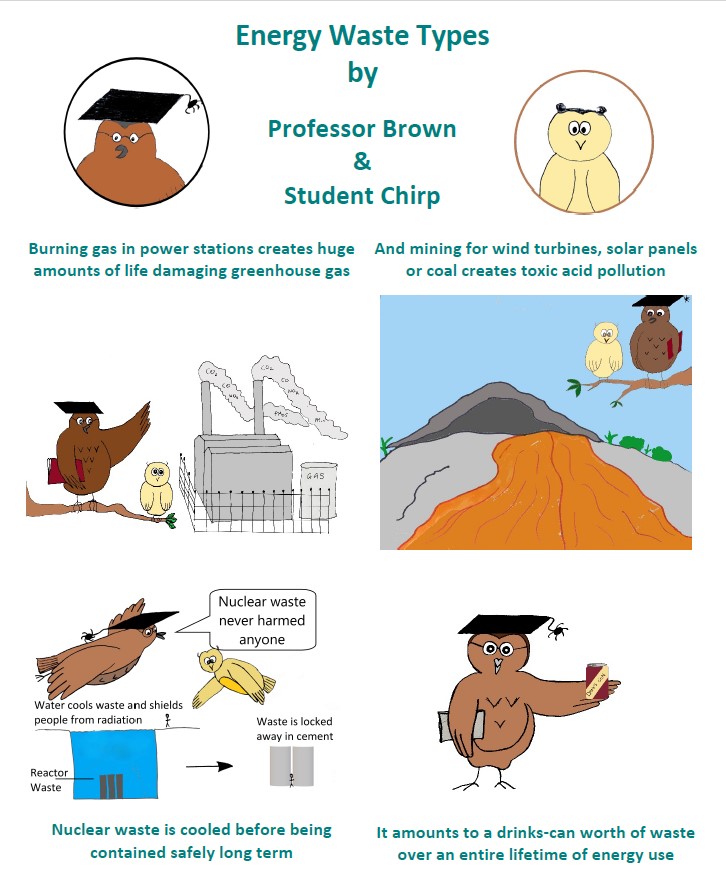
    Contrary to media reporting, radioactive waste is not a public health hazard, and it never hurt anyone. The issue of public mistrust is discussed here.

    Emissions from burning fossil fuels, on the other hand, cause devastation worldwide by contributing to more frequent and intense extreme weather events like typhoons, droughts, and famines.

    Also note significant chemical waste arises from the materials needed for intermittent energy technology around which the grid burns gas.

    The nuclear industry is held to incredibly high account for the waste produced. The radioactive content mostly consists of heavy metals, and this is published in the publicly available UK radioactive waste inventory. A natural fission reaction below Gabon, which happened 2 billion years ago, and the ‘waste’ is still there; it hasn’t harmed anyone or anything.

    Secondly, from the discussion with Dr Pete Bryant of Sizewell C, it is pointed out that although people immediately think of radioactivity from nuclear fission, the issue in practice is more about the excess heat that, for thermodynamic reasons to do with the Rankin/Carnot cycle, like with any thermal plant, poses more of a problem for those occupied with building a nuclear power station than the very small amount of contained solid waste.

    Third is the consensus around what constitutes the level of radioactivity that we should be concerned about. 

    The current regulations for ionising radiation are largely based on a dose-response relationship established over 80 years ago by Herman Mueller, using very basic technology at the time. This framework operates on the unproven assumption of a stochastic effect that only ‘no dose’ is a safe threshold.

    See our 3 minute video which explains the problems of LNT:

    However, with advancements in monitoring technology, we now know that low background radiation exists globally, and our bodies are well-adapted to it.

    Given the nuclear industry is regulated to ensure public exposure doesn’t exceed 1 mSv per year (for perspective, this is lower than the natural background radiation in Cornwall, which is 2.7 mSv), it’s little wonder why nuclear new builds have become increasingly costly and timely. In some areas of the world, background radiation levels exceed 200 mSv with no adverse health effects observed in those populations.

    It seems we have a choice: either we base our regulations for low-dose radiation on actual evidence, or we apply equivalent pollution levies to greenhouse gases.

  • Global Warming

    What is Global Warming?

    Global warming is a phenomenon related to increased levels of carbon in the atmosphere, particularly carbon dioxide gas.  Carbon-dioxide is a chemical product of burning carbon-containing materials such as coal, oil, gas, wood and paper.

    Carbon dioxide is a ‘greenhouse gas’ meaning it has a particular property whereby it can absorb heat energy (infra-red), which has bounced off the surface of the earth, and re-distribute it back into the atmosphere, rather than allowing it to pass back into space, hence an overall trapping of heat energy. This is fine as long as the balance is right.

    Before the invention of the steam engine, the carbon dioxide concentration in the atmosphere was just under 280 parts per million (ppm); it has since risen to 419 ppm, which is more than 50% increase over pre-industrial revolution levels.

    We have proof that this imbalance is heating the planet, droughts are becoming more widespread and for longer and contributing to war and famine, ice is melting in the polar regions and mountainous areas, migratory patterns and therefore biodiversity is affected, and many habitats of fellow creatures are dying.

    In addition we are seeing changes in the way of ocean acidification, which has already caused changes in colour to parts of the great barrier reef, and is expected to affect shellfish populations. The ability of these fragile systems to continue to thrive is looking increasingly unlikely as most countries’ leaders continue to make superficial and trivial changes. Although the rate of ocean heating is equivalent to about 5 nuclear bombs per second, energy policies worldwide continue to incentivise fossil fuels over nuclear energy.

    Unfortunately, many academics, encouraged by radio-phobic organisations such as Campaign against Nuclear Disarmament, Friends of the Earth and Greenpeace, have plenty of public support in issuing ill-informed arguments on how to manage our predicament.   To think that  de-carbonisation is possible without nuclear energy goes against the IPPC reports and basic mathematical reason.

    As heating and transportation are most energy intensive, it makes sense to replace gas, coal and oil with nuclear powered electricity, including combined heat and power systems, and electric public transport sourced from a nuclear powered electric grid.


  • JOAN PYE SPEAKS AT SUSTAINABILITY LIVE, NEC

    Joan Pye will be speaking today, 19 May 2009, at Sustainability Live, a conference accompanying an exhibition on Climate Change Solutions – Generating a Low Carbon Future at the NEC.  Other speakers include:

    The Rt Hon Ed Miliband – M.P Secretary of State for Energy & Climate Change;
    Olwen Dutton, Chief Executive, Regional Partnership, WM Regional Assembly, West Midlands Local Government Association;

    Rhian Kelly, Head of Climate Change Group, Confederation of British Industry.

    Joan will be putting forwards the case for nuclear energy as a clean, green, cost-effective, proven solution to meet the UK’s energy needs.

  • Fells Associates report

    Joan Pye and her supporters have been in touch with Professor Ian Fells, co-author of the recent report “A Pragmatic Energy Policy for the UK.”