Anecdotal stories from industrial accidents are upsetting, but why those involving the nuclear industry are perceived to be worse than those from other industries is illogical, but why?
For example, the Piper Alpha oil rig explosion which also occurred in the eighties, and killed 167 men is rarely brought up in discussions of safety, suggesting a widespread lack of understanding of facts.
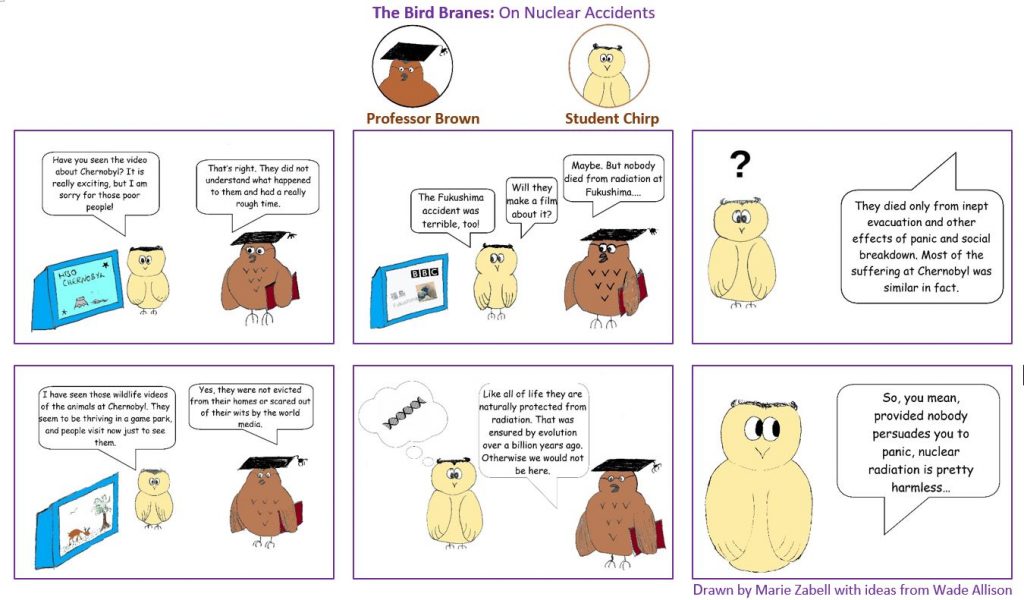
People feel less fearful about a perceived risk if they feel in control of it (eg driving), or the hazard has been normalised (e.g. car accidents). The nuclear fear example often cited is that people don’t want another Chernobyl. Yet, apart from the 28 staff and emergency workers killed from direct impact or exposure, even this – the worst nuclear accident – caused, for the most part, an exposure to radiation levels comparable to, or a few times higher than annual levels of natural background.
The Oxford Martin School Radiation Restatement written in 2017 has estimated 15 statistical thyroid cancer deaths are likely to be attributable to increased exposure to radiation from this incident.
Nuclear Accidents:Professor Brown and his student Chirp, discuss high profile accidents in the media. View animated version here
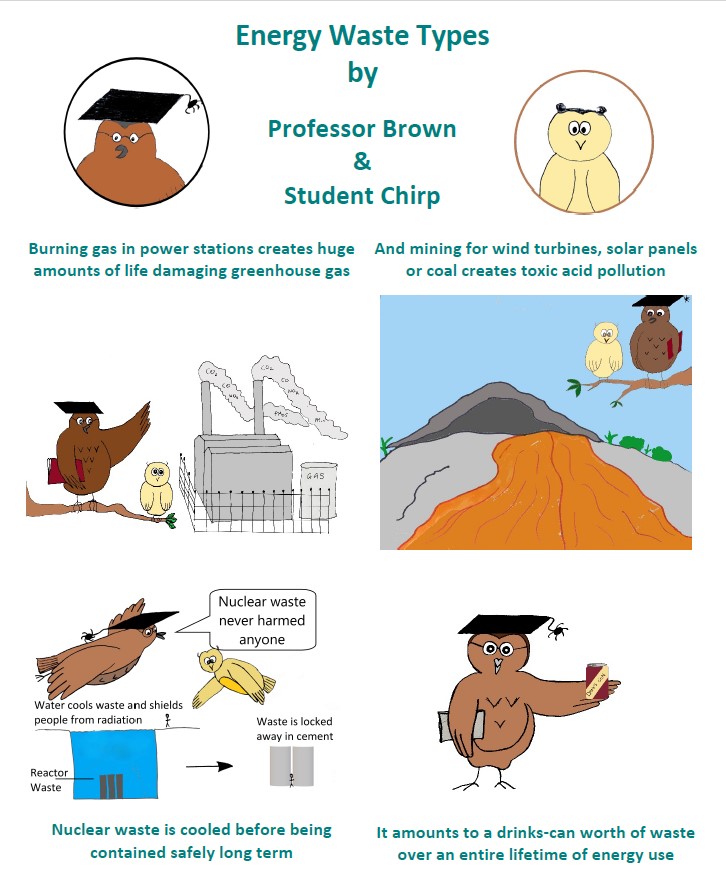
Contrary to media reporting, radioactive waste is not a public health hazard, and it never hurt anyone. The issue of public mistrust resulting from mainstream propaganda is discussed here. A natural fission reaction happened below Gabon, 2 billion years ago, and the ‘waste’ is still there; it hasn’t harmed anyone or anything.
The Simpsons’ three eyed fish is unrealistic. When Herman Muller investigated ‘mutations’ to cells from ionising radiation (X-Rays) in the 1920s, mistakes were made, creating an overcautious approach to low level radiation. So, apart from natural background anomalies, the ICRP now very much overestimate the potential for radiologically induced cancers from low level radiation (ie less than 100 mSv). In addition, the sci-fi industry exaggerated the word ‘mutation’ into macroscopic inheritable defects. The truth is that chemical poisoning, consider, e.g. tar vs polonium in cigarettes, is far more damaging.
Chemical properties of wastes ought generally to be considered in context against radiological properties for energy wastes. Consider the knock on effects of combustion of fossil fuels, a chemical reaction which produces an uncontrolled waste stream of carbon dioxide and water. For example we can see that one molecule of methane reacts in an irreversible process with oxygen and this creates one molecule of carbon dioxide and one molecule of water. CH4 + 2O2 => CO2 + 2H2O .
As carbon dioxide (CO2) from burning fossil fuels accumulates in the relatively thin atmosphere where it stays for hundreds of years, and uniquely, those electrons around the carbon dioxide molecule absorb and re-emit heat (infra-red radiation), it means there is mainly more energy of this range trapped beneath the stratosphere.
As a result of this increased trapped energy we are presently seeing more frequent and intense extreme weather events like typhoons, or droughts, resulting in excess deaths from heat stroke, famine, disease and pestilence, yet current energy policies do nothing to prevent the wastes even though the world temperature has increased by 1.5 degrees since the start of the industrial revolution and is accellerating up.
Although the nuclear industry does not create carbon dioxide, it is still held to an incredibly high account for the radiological wastes which are cooled and contained. The radioactive content mostly consists of heavy metals, and this is published in the publicly available UK radioactive waste inventory.
In fact, from the discussion with Dr Pete Bryant of Sizewell C, it is pointed out that although people immediately think of radioactivity from nuclear fission, the issue in practice is more about the excess heat that, for thermodynamic reasons related to the thermal plant, pose more of a problem for those occupied with building a nuclear power station than the very small amount of contained solid waste.
There is emerging consensus around what constitutes the level of radioactivity that we should be concerned about as current regulations for ionising radiation are largely based on a dose-response relationship established over 80 years ago by Herman Mueller, using very basic technology at the time. Mueller’s dose-response linear no threshold hypothesis operates on the unproven assumption of a stochastic effect that only ‘no dose’ is a safe threshold.
As such, the the nuclear industry is regulated to ensure public exposure doesn’t exceed 1 mSv per year (for perspective, this is lower than the natural background radiation in Cornwall, which is 2.7 mSv). We now know that low background radiation exists globally, and our bodies are well-adapted to it. In some areas of the world, background radiation levels exceed 200 mSv with no adverse health effects observed in those populations.
Given this extreme enforcement with reference to low level radiation it’s little wonder why nuclear new builds have become increasingly costly and timely.
It seems we have a choice: either we base our regulations for low-dose radiation on actual evidence, or we apply equivalent pollution levies to greenhouse gas wastes from burning of fossil fuels.
See our 3 minute video which explains the problems of LNT:
Global warming is a phenomenon related to increased levels of carbon in the atmosphere, particularly carbon dioxide gas. Carbon-dioxide is a chemical product of burning carbon-containing materials such as coal, oil, gas, wood and paper.
Carbon dioxide is a ‘greenhouse gas’ meaning it has a particular property whereby it can absorb heat energy (infra-red), which has bounced off the surface of the earth, and re-distribute it back into the atmosphere, rather than allowing it to pass back into space, hence an overall trapping of heat energy. This is fine as long as the balance is right.
Before the invention of the steam engine, the carbon dioxide concentration in the atmosphere was just under 280 parts per million (ppm); it has since risen to 419 ppm, which is more than 50% increase over pre-industrial revolution levels.
We have proof that this imbalance is heating the planet, droughts are becoming more widespread and for longer and contributing to war and famine, ice is melting in the polar regions and mountainous areas, migratory patterns and therefore biodiversity is affected, and many habitats of fellow creatures are dying.
In addition we are seeing changes in the way of ocean acidification, which has already caused changes in colour to parts of the great barrier reef, and is expected to affect shellfish populations. The ability of these fragile systems to continue to thrive is looking increasingly unlikely as most countries’ leaders continue to make superficial and trivial changes. Although the rate of ocean heating is equivalent to about 5 nuclear bombs per second, energy policies worldwide continue to incentivise fossil fuels over nuclear energy.
Unfortunately, many academics, encouraged by radio-phobic organisations such as Campaign against Nuclear Disarmament, Friends of the Earth and Greenpeace, have plenty of public support in issuing ill-informed arguments on how to manage our predicament. To think that de-carbonisation is possible without nuclear energy goes against the IPPC reports and basic mathematical reason.
As heating and transportation are most energy intensive, it makes sense to replace gas, coal and oil with nuclear powered electricity, including combined heat and power systems, and electric public transport sourced from a nuclear powered electric grid.
Joan Pye will be speaking today, 19 May 2009, at Sustainability Live, a conference accompanying an exhibition on Climate Change Solutions – Generating a Low Carbon Future at the NEC. Other speakers include:
The Rt Hon Ed Miliband – M.P Secretary of State for Energy & Climate Change;
Olwen Dutton, Chief Executive, Regional Partnership, WM Regional Assembly, West Midlands Local Government Association;
Rhian Kelly, Head of Climate Change Group, Confederation of British Industry.
Joan will be putting forwards the case for nuclear energy as a clean, green, cost-effective, proven solution to meet the UK’s energy needs.