
Security of Supply for Affordable Future Energy
Security of supply is a fundamental consideration in deciding our energy future and has a major bearing on the price we pay for electricity and on whether we have enough to meet growing demand. An inevitable consequence is higher electricity bills for the consumer.
Issues of securing fossil fuels to burn
Today, the majority of our electricity is produced by burning fossil fuels, in particular coal and gas. The UK is already a net importer of these since we don’t have enough of our own. Oil and gas account for most of our energy imports, whether directly for transport or via electricity.
This means we are less able to control the price of electricity in the UK and remain hostages to the future of oil and gas markets if we are unable to agree a price for the fuel we import.
Gas fired power stations now account for the largest proportion of electricity generation in the UK and we already import 60% of the gas required. Natural gas from the North Sea and Irish Sea provides a large proportion of UK gas supplies. However, in recent years there has been a shift towards importing natural gas via pipelines in Europe and Norway, as well as shipping Liquefied Natural Gas (LNG) from other parts of the world.
An obvious example of uncertainty in gas supply relates to the fact that the EU has been at the centre of dispute between Ukraine, and Russia, from which the EU imports one third their gas supply. It could easily be prevented from being piped through the Ukraine [1].
Nuclear Fuel is easier to obtain
Uranium is approximately as common as tin or zinc in the Earth’s crust, occurring in most rocks and also the sea. Its distribution in commercially extractable concentrations is shown below. The reserves are price-sensitive, but there is little doubt that these are sufficient to last mankind.
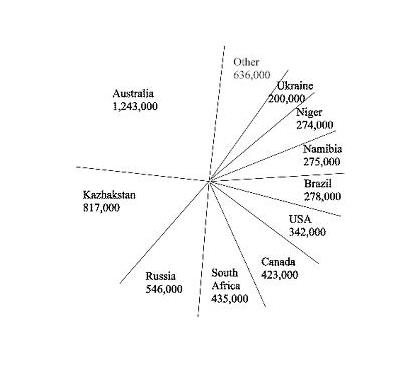
Figure shows worldwide distribution of identified uranium supplies (in tonnes of metal) recoverable at $130 per kg of uranium [c/o Radiation and Reason by Wade Allison].
In addition, smaller quantities of fuel are required so fuel costs remain a minor proportion of overall electricity costs.
With the nuclear option therefore, we have far stronger control over the price we pay for our electricity and above all better security of supply to meet growing demand.
‘Alternative Energy’ Sources are Distractions
‘Renewables’ harness energy from their environment. Wind, solar, wave and tidal, for example, are driven by natural earth cycles. Unfortunately, these sources cannot be relied on to generate in the region of their maximum electricity output at all future times of high electricity need. This results in intermittency problems that put incredible strain upon the national grid.
A dedicated thinker and logistician, Professor David MacKay collaborated with the public in producing a freely available book which has detailed analysis of the realistic provision from each of these energy sources in ‘Sustainable Energy Without Hot Air’.
Unfortunately, the image of nuclear as a civil power source is controversial due to the fear of low level radiation creating illness or genetic mutations. These worries are completely unfounded, and a sole product of propaganda by entertainment outlets, journalists and even politicians during the cold war.