Renewable energy, many think, is the answer to all our energy issues, and there is no fault in wanting to minimise our reliance on carbon-based fuels borne out of a concern for the environment, but there must be caution against advocating for renewable energy as a sole solution to our global warming predicament. Even in adopting ‘a bit of everything in the mix’, are wind, solar and tidal power really any kind of substitute for affordable and plentiful low carbon electricity? Why are these technologies not successful, when, despite many years of Government initiatives, our energy prices and greenhouse gas emissions continue to rise? We need at least 50GW carbon free electricity on the grid, yet we have nearly 50GW installed capacity of wind plus solar, funded by loans to the bill payer via a private equity firm called the Low Carbon Contract Company. This is ON TOP of 48 as fired power stations. And when the last coal-fired power station shut in 2024 we had to import from the continent!
Not only would we argue that renewables are superfluous to requirement, but wind turbines and solar panels are land-intensive; and material intensive for the energy they produce. In addition, hydro-power, solar and wind are relatively destructive with a high ecological impact due to the low amount of energy they deliver, from mining to waste disposal. Unpredictability and intermittency of a weather dependent supply cannot be solved by batteries, which store energy for no more than hours. Plus, intermittent sources are backed by methane-intensive gas power, and increasing imports in order to fit peak demand. See below for last years’ Fuel type power generation production.
If we replaced wind (turquoise), solar (yellow), gas (orange) and imports (pink etc) with nuclear energy we could at least decarbonise the grid. The pink is imported nuclear derived electricity from France.

The truth is, is that whilst irrational fears of nuclear energy dominate people’s understanding of electricity supply, the reality is that by closing low carbon nuclear plants in favour of solar and wind farms, the difference is invariably replaced by gas, coal or expensive imported electricity.
Anti-Nuclear Bias
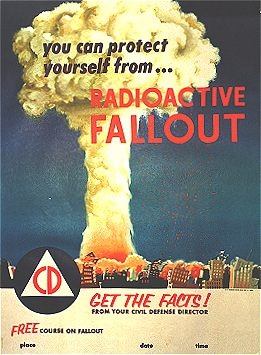
Misinformation about nuclear energy stems from cold war political propaganda and also the persistent use of the Linear No Threshold (LNT) model which was unreliably adopted in the 1950s on the assumption that no dose of radiation is the only safe level. Significant flaws of evidence in this model are that it ignores the facts that:
- we have been exposed to radiation since life first evolved on earth. High-sensitivity radiation detectors show that it’s impossible to completely escape it, and
- plenty of evidence determines that cells can and do repair following low-level radiation exposure
Back Up Power – What if renewable energy is actually keeping us dependent on gas?
In general, the national grid relies on a steady controlled generation of power from generators and turbines. This can be supplemented by occasional “chaotic” power generation such as that provided by wind and solar, but cannot depend upon it. To avoid black out and “crashing” the grid, wind power and other renewables must be supplemented at all times by a back up generation capability (ie gas) equal to 80-90% of the installed renewable energy capacity, so that when the wind drops, the tide turns or day turns to night there is reserve to avoid failure.
Bear in mind, that gas transmission has the unavoidable problem of leaking methane, which is 80 x more damaging as a greenhouse gas than carbon dioxide and so we should be trying to eliminate as much of this as possible. However, it is the only current fuel source which can respond quickly to changing patterns of weather upon which variable renewable energy technologies depend.
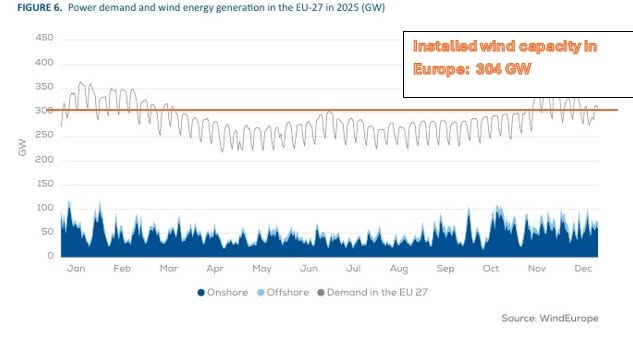
Take wind capacity below for the whole of Europe: we see the extreme peaks and troughs. Whilst the combined onshore and offshore installed capacity is 304 GW, theoretically constructed to match the demand, there is a huge amount of potential energy wasted because of the unreliability of wind and the output is only somewhere between 10 and 15% of that installed. The difference between supply and demand is filled with gas, which have to work around the fluctuations. This excess ramping of gas turbines is inefficient and can generate higher emissions due to start-stop idling as opposed to running at a steady rate.
Renewable energy cannot be stored and is difficult to manage, despite heavy investment in battery power and smart grids. Variable weather-dependent power is intermittent so that when the wind drops (or the sun goes down), the power stops and this is backed by a significant amount of gas.
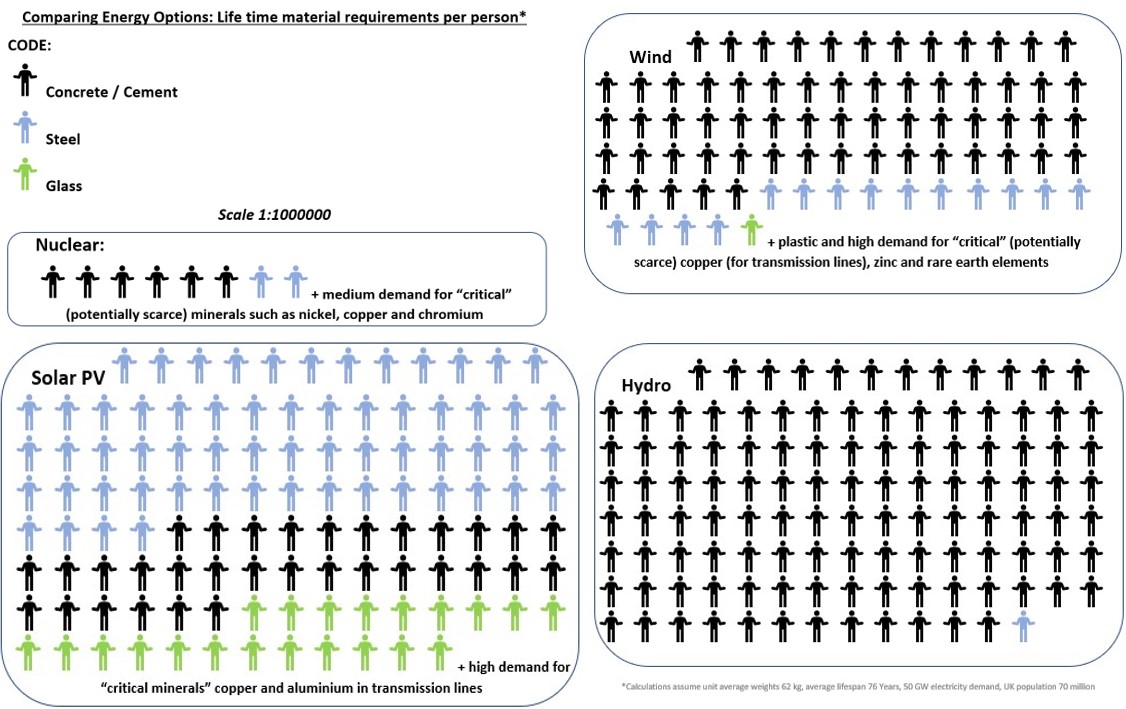
Renewable power generation is heavily resource dependent. Let’s take into account materials such as concrete, glass and steel needed for a lifetime’s supply. Nuclear has a high energy density (1kWh per kg) which is 10 billion times better than this because, counterintuitively, the size of the atomic nucleus is so small that it contains much more potential energy compared with the max speed of wind / water.
Renewable installations require significantly larger land footprints to deliver equivalent volumes of power compared with conventional power stations. A proposed solar farm by EDF in Cambridgeshire will deliver only 0.01% of the UK’s electricity needs, despite being nearly the same size as Cambridge itself.

To produce 1,000MW of electrical energy – the size of an average power station – nuclear requires the equivalent of 10 football pitches. Wind (when it is blowing) requires an area the size of Dartmoor, and solar would need half as much again. Biomass (wood) needs a forest the size of Wales. Britain currently needs at least 55 of these 1,000MW(e) power stations to meet peak demand and renewables come nowhere near to meeting the requirement.
Wind turbines and solar farms require vast areas of land or sea to generate the same output as a single conventional power station.
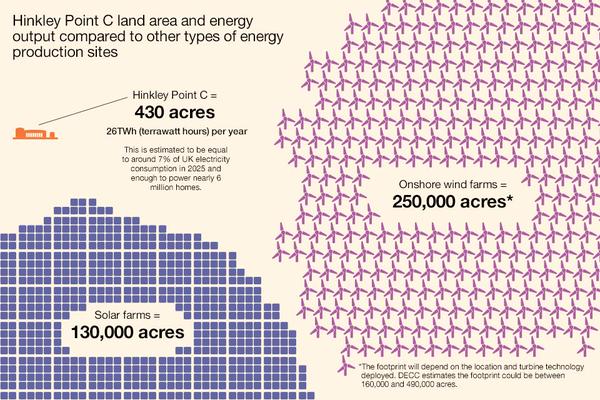
An equivalent wind farm is estimated to require in the region of 400-1000 times more land than a nuclear powered facility.
Balancing the Grid
The “quality” of our electricity is very important, since microprocessors and electric motors rely on the stable voltage and frequency of the supply to work properly. It was an important achievement of the 1926 Electricity Act to unify the voltage and frequency throughout the UK by joining up selected large power stations, working in unison through the “Grid”, to give us our present reliable high quality electricity. A multitude of turbines is reversing this process, and if continued to any great extent, would endanger the quality of our electricity and possibly cause power cuts.
There are now 12,000 wind turbines on / offshore in the UK, which can produce large quantities of energy, but this is wasteful when it is deemed superfluous to requirement. If the UK covered every roof with solar panels, and all accessible coastline with wind turbines, we’d still only have a fraction of the electricity supply necessary to meet demand.
Biomass – burning wood for energy
Burning wood instead of fossil fuels has its own problems. To plant enough willow to keep a single 1,000 MW (e) power station operating would cover an area bigger than Kent. As wood is cellulose, a carbohydrate, less than half of its weight (the carbon part) burns to produce heat, the rest evaporates as water; it is thus half as productive per tonne as coal and is actually very poor in energy content. To keep up with our renewables obligations, the UK burn wood chip in combination with coal in conventional power stations at Drax and Lynemouth.
Solar
The issues with Solar energy are much the same as wind as it can only be collected only during day, when there is no heavy cloud cover. Photovoltaic solar panels take sun’s light and convert it to electricity. This output will vary throughout the day, as sun rises to a maximum and then declines. Thermal solar panels can take sunlight and absorb the heat to warm up water for domestic or industrial use. These are more efficient than photovoltaics, however they aren’t a recipe for self sufficiency. Even in perfect conditions, the amount of energy available has a modest upper limit.
Wave power – tidal streams
For tidal streams to generate a reasonable amount of energy ie 1000 MW, 1000 turbines are needed. The capital cost is quite high, the carbon emissions are low, but as the generation of tidal power is not constant and electricity can only be generated when the tide is running, it too has to be supported by 80% of the installed renewable energy capacity, to avoid black outs.
Economics
Without government subsidies, many of the existing and proposed wind and solar farms we currently see would be uneconomic. Contracts for Difference (CfDs) are the UK government’s main mechanism for supporting low-carbon electricity generation. CfDs provide renewable energy developers with a guaranteed “strike price” for electricity produced. The payments, and repayments, paid are passed on to consumers’ electricity bills via an intermediary loans company. This means, that as a result of pro-renewable, anti-nuclear energy policies, the UK now has amongst the highest electricity bills in the whole of Europe.
Wind power is the largest renewable energy provision in the UK according to figures presented by the suppliers. If the wind farm supplies more than the grid requires, the windfarm suppliers are asked to switch off and then require compensation. This payment makes up a large percentage of the Balancing Use of System (BSoUS) section you can find on your electricity bill [Ref].
Conclusion
So what to do? We shouldn’t completely discount renewable energies. Solar panels can make sense on traffic road signs and calculators for example. But to deal with the energy crisis facing us in terms of the growing gap between capacity and demand we have to refocus the debate and look at a reliable and realistic generation solution for the UK, that is nuclear energy, available all times other than during refuelling. The reliability or ‘capacity factor’ as is known in the industry, for a nuclear-derived supply, is 92%.
Download our White Paper: renewables-misnomer