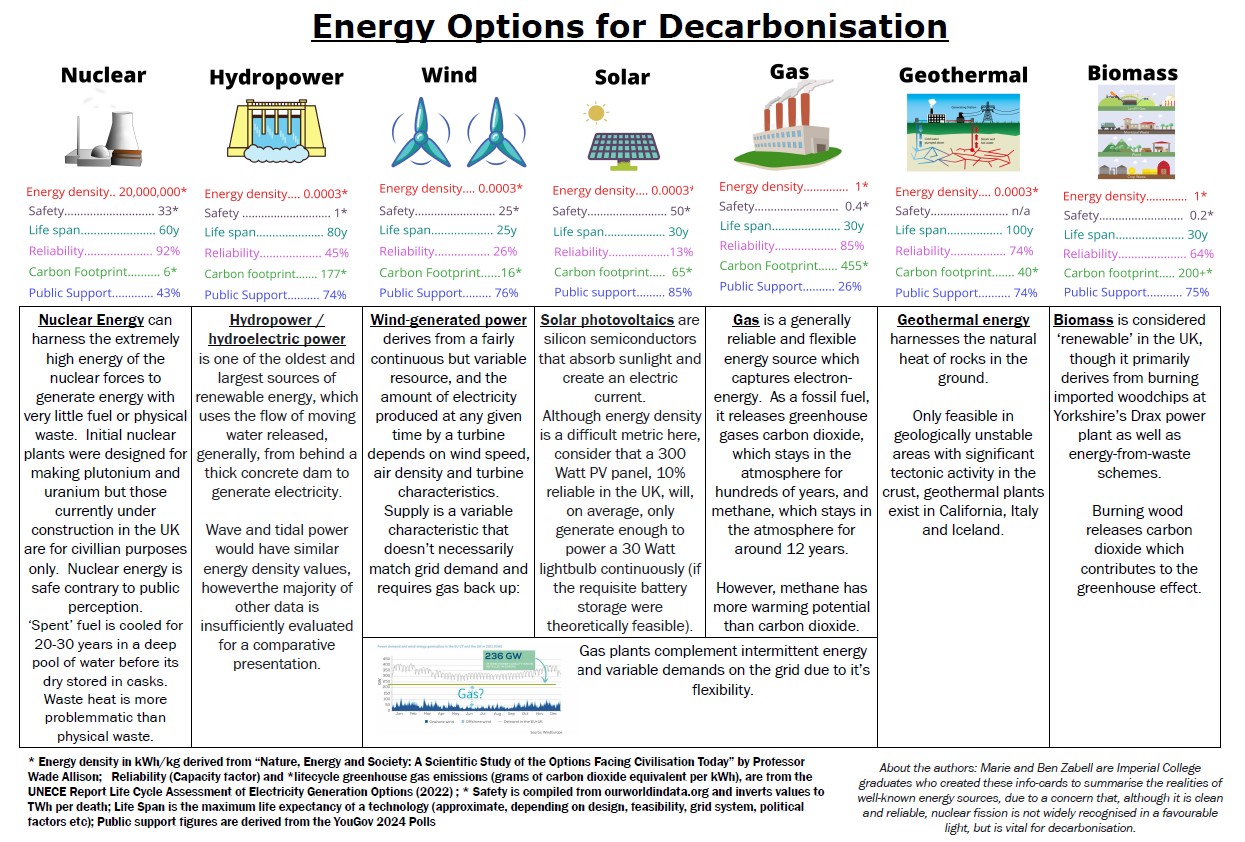
This page is an attempt to demonstrate how political and social factors do influence the price of electricity, however ambiguous that has become with underlying agendas and where subsidies have become convenient ways to hide the truth. This ambiguity is why we put together a list of technical properties per TWh.
Historical context
The initial suite of commercial British nuclear reactors that supplied electricity to the grid were called ‘Magnox’ reactors, primarily based around the UK coast, as well as the inland site at Trawsfynydd. Magnox had a dual purpose of both providing clean energy for the grid and of manufacturing plutonium 239 for weapons stockpiling.
The propaganda to which the UK was also subject at this time, was designed to make the freedoms of capitalism and privateering seem attractive compared with communist ideals of equality. One message that came across with it, was the threat of ‘dangerous nuclear fall out’ and this was exaggerated in film, television, music, literature and art and this continues through to the present day, making people extremely suspicious of nuclear energy.
Although nuclear power plants tend to be expensive to build, they are relatively cheap to run due to the tiny fuel requirement (5g uranium per person per year). This is perfect for providing low cost energy to the masses, and in line with socialist aims such as those endorsed by the Green Party, who, ironically remain unconvinced.
The last new power station in the UK was a gas reactor built at Sizewell, Suffolk 40 years ago, and this took 7 years to construct. At the same time, the Thatcher government decided to ‘privatise’ ie sell off UK assets to the ‘free’ market, ultimately fragmenting the National Grid. Energy policy and economics have since favoured globally-procured, cheap, carbon-based tech, with efforts thrown toward renewable projects by subsequent governments in order to appease those who care about climate effects. Which is odd given the fact that when you look at it, their poor reliability ultimately keeps us dependent on gas fired power stations (CCGT)!
Despite discussions since 2010, as of 2026 there are just two nuclear power sites under construction in the UK; one at Hinkley Point C in Somerset and the other just started at Sizewell in Suffolk, this slowness is mostly due to lack of social or political will or outright opposition by uninformed NIMBYs.
UK Policy Impacts & New Build financing
Cost models rarely reflect value for money. Consider for example, how one might favour wind and solar energy sources on the presumption that the fuel is ‘free’, without considering the extra connections and balancing problems (‘externalities’) that the grid has to manage in order to allow intermittent sources to feature in the mix over and above a consistent energy source.
These days, the UK bill payer can decide which middle-man supplier they want to buy electricity from, but realistically, electricity from the various sources, seen below, all feed into the same electric network, and cannot be divvied out according to our payments. So this is an illusion of choice.
The snapshot from Gridwatch beneath shows how the grid is fed by numerous sources, increasingly from interconnections via undersea cables to the continent (pink). The majority share comes from gas power stations (orange), with its pricing linked to imports. Thanks to its flexibility, gas is a primary fuel of choice to partner with renewable sources (turquoise and yellow) since batteries are not a realistic substitute for backup, storing electricity only for hours.
Despite having a total renewable capacity of around 50 GW, well over and above our total demand, the average usable output is around 10GW. This over-build of renewable capacity negatively affects electricity prices, and is most likely to be hidden in the bill payer’s ‘third party costs’*, which account for about 60% of the whole bill.

The Low Carbon Contracts Company are the people who secure loans to the Government to support the integration of clean energy to the grid as well as questionable projects such as sustainable aviation fuel and carbon capture and storage. As a third party, loan costs are ultimately passed on the the consumer.
The subsidy mechanism which locks in the many renewable energy projects to the grid by ensuring payments get to providers for power that can outstrip demand, is called ‘Contracts for Difference’. It is seemingly another mechanism intended to work in favour of the investor rather than the end user, who will effectively pay for wasted electricity at these times.
On the positive side, in November 2021, the UK Government introduced a Nuclear Energy (Financing) Bill which set out a framework to encourage free market investments, using the Regulated Asset Base Model, reportedly adding an extra £1 per month to consumer bills. 2025 saw a financial commitment from the Government, and work has finally started to build 3 GW capacity at Sizewell C.
New Nuclear
The current political push, to keep with investor-driven and potentially risky commercial decisions for our energy provision, is to popularise the idea of small modular reactors, many of which are still being developed by investors who set up deals with DESNZ in 2025.
Honestly, our leaders need to do better than this.
Other references
Homepage – Dieter Helm – Economist with honest advice
World Nuclear News Symposium: Financing nuclear projects
World Nuclear Association: Financing Nuclear Energy
Kirsty Gogan of Lucid Catalyst presents to an American Audience (2019) The Potential for Nuclear Cost reduction: Making a clear commitment with public confidence in a fleet of similarly designed reactors would be an effective way to dispatch low carbon energy to meet demand
The Future of Nuclear Power – the Role of Nuclear power in a low Carbon Economy – a report by the UK’s DTI, although from 2007, provides a good source of information concerning nuclear technology and costing strategies.